World Action Planner: robots check actions against imagined futures
A research system combines visual and language understanding with a world model. It explores possible outcomes of robot movements before selecting actions to execute.
The short answer
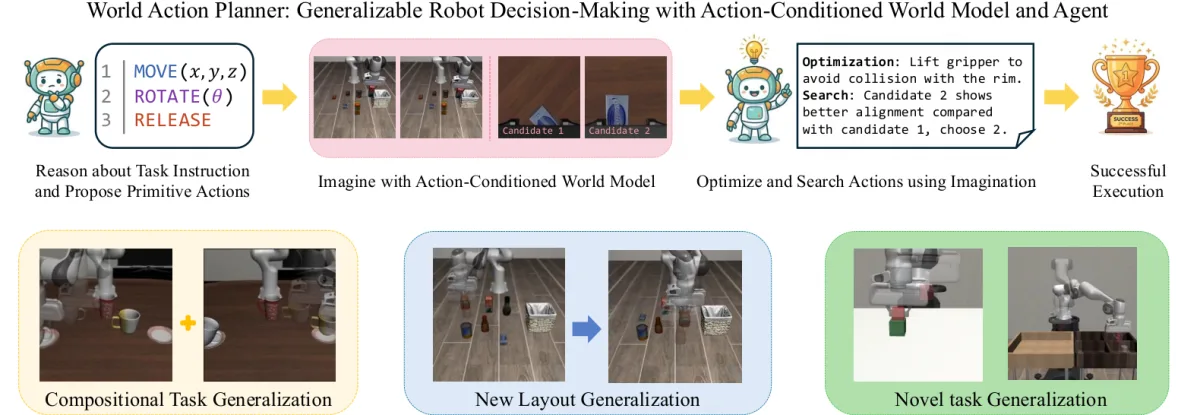
Put the green can into the white basket. The instruction sounds simple, but a robot still needs to connect the target, grasp position and movement path. World Action Planner explores how imagined action sequences can help it do that. Xiangcheng Zhang, Runhan Huang and Yilun Du first submitted the paper on July 30 and updated it on October 2, 2026. This article covers the revised version.
A broad plan, followed by a closer search
The system proposes actions and uses an action-conditioned world model to imagine their consequences. It first refines the overall plan, then compares nearby candidates in a more detailed search. The project page includes a real robot arm placing a can into a basket. The researchers also examine unfamiliar object layouts and composed tasks. The original figure illustrates the process; the imagined image sequences should not be mistaken for actions the robot has already performed.
Prediction needs a reality check
Our view: spotting a poor movement plan before trying it on a real object is an appealing idea. That does not establish that every contact can be predicted reliably. In a practical evaluation, we would ask how often imagined movements differ from what actually happens. We would also want to know whether the robot stops when uncertain and how much time the extra planning requires. These are questions for a deployment test, not properties that Findbest has measured for this research system.
Announcement date: 2 Oct 2026
What changed?
The updated paper describes planning through a world model rather than relying only on directly imitating familiar demonstrations. Its authors report improved results against the approaches they compare on their selected tasks. Those are the team's findings, not an independent validation by Findbest.
Who is this relevant to?
The work is relevant to robotics developers and readers interested in how an AI instruction becomes a physical movement. Anyone considering equipment for a workplace should distinguish a research result from a supported application that has been approved for the intended environment.
What this means for your work
Our assessment: a useful evaluation would change one condition at a time, such as the basket's position. That could help reveal whether a system replans the job or repeats a familiar motion. A clear demonstration gives us a question to investigate; it does not answer it for every possible setting.
Limits of this report
This is an arXiv research report, not a product release or safety certification. Results on selected tasks cannot establish performance across an entire factory. Findbest has not tested a robot. Revised October 2; sources checked October 5, 2026. Original Figure 1 is used under CC BY 4.0, with technical resizing and WebP conversion only.
More images
Select an image to view it in full at a larger size.
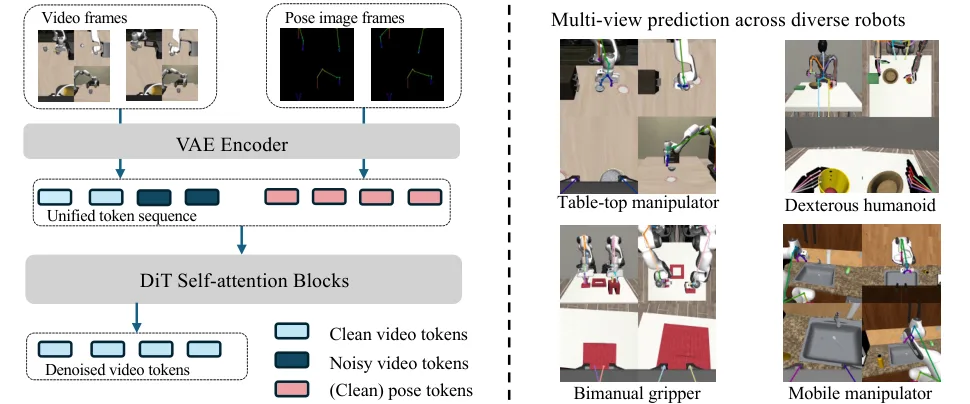
How the world model receives information about planned actions. Original figure 2 from the research paper; resized and converted to WebP for this website, with no changes to its content.
Xiangcheng Zhang, Runhan Huang, Yilun Du · Fig. 2 · CC BY 4.0 · Image source · CC BY 4.0Read next

AI research: from answer to reliable source
A compact workflow for checking claims transparently.

Introduce AI to a small team: run a pilot before adding subscriptions
Use real tasks, a simple evaluation sheet and a clear decision to find out whether an AI tool helps your team.
Check AI answers: turn source links into supported claims
A source link is not enough. Check what it actually supports and whether the context matches.
Was this article helpful?
Your feedback helps us improve our articles.
Votes are counted per language version. Repeat voting is limited; totals do not necessarily represent distinct people. Privacy