GlowTact: a compact touch sensor makes robot contact visible
GlowTact turns contact at a robot fingertip into a camera image. Its researchers demonstrate fine screw-thread detail and detection of lightweight contact.
The short answer
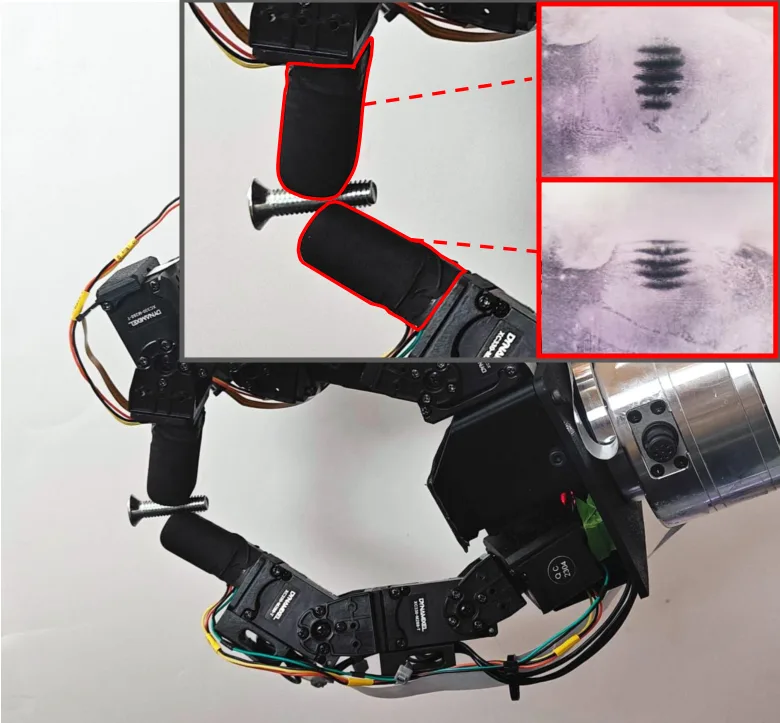
In the original research image, a robot hand holds a screw. Beside it, contact images reveal the thread pattern. That is the idea behind GlowTact, a compact optical touch sensor for robot fingertips. The paper was first submitted to arXiv on September 26; its current version is dated October 2, 2026. This is a research development, not an announcement of a consumer product available today.
Pressure becomes a visible pattern
A black membrane rests above a transparent gel with a finely textured surface. Contact changes the optical coupling, making loaded areas appear darker to a camera. The design uses single-colour illumination. The authors demonstrate lightweight contact detection and fine detail, including M1 screw threads. Their original figure shows a GlowTact-equipped LEAP hand and the resulting contact images. It is the team's research image, not an AI-generated depiction of a robot.
A small component with a larger job
Our assessment: grasping requires more than locating an object. A robot also needs information about what happens when its fingers make contact. In an evaluation, we would look beyond the sharpness of a sensor image. Does the whole hand hold a part more reliably? What happens when the surface is dirty? Does the measurement remain stable after repeated use? These questions concern the sensor, controller and mechanics working together. Findbest has not performed those experiments.
Announcement date: 2 Oct 2026
What changed?
The revised publication presents a compact sensor for optically recording contact information. The researchers describe an approach suited to sensitive robot fingertips. Their measurements establish results within their experiments, rather than performance under every possible operating condition.
Who is this relevant to?
The work is relevant to developers of grippers and robot hands. For a wider audience, it illustrates how progress in robotics can depend on a small sensing component. Our view is that a better action plan still needs useful information about the contact that actually occurs.
What this means for your work
For a practical trial, we would choose a defined part and repeat the same grasp many times. Successful attempts would be only one measure. Slipping, damage and recalibration would also matter. That would help establish whether a more sensitive fingertip improves the entire job, instead of merely producing a more detailed image.
Limits of this report
The paper provides research results, not a promise of a production release, confirmed availability or a retail price. Findbest has not tested the sensor. Revised October 2; sources checked October 5, 2026. Original Figure 1 is used under CC BY 4.0 with technical resizing and WebP conversion only; its content is unchanged.
Read next
AI research: from answer to reliable source
A compact workflow for checking claims transparently.

Introduce AI to a small team: run a pilot before adding subscriptions
Use real tasks, a simple evaluation sheet and a clear decision to find out whether an AI tool helps your team.
Check AI answers: turn source links into supported claims
A source link is not enough. Check what it actually supports and whether the context matches.
Was this article helpful?
Your feedback helps us improve our articles.
Votes are counted per language version. Repeat voting is limited; totals do not necessarily represent distinct people. Privacy